
In this module, we will describe The Spectrum of Prevention framework and explore how it can be used to Address Health Equity

Health equity means that everyone has a fair and just opportunity to attain their full health potential and that no one is disadvantaged, excluded, or dismissed from achieving this potential. At Prevention Institute, we focus on how structural drivers of inequity—such as racism, sexism, and income inequality—impact communities. And we support community-based organizations and advocates in building power and capacity to change the systems that created these inequities in the first place.
Racial justice is a primary focus of Prevention Institute’s health equity work because racism, discrimination, and other forms of racial injustice have resulted in dramatic health and safety disparities for communities of color. Without closing racially unjust gaps in health outcomes, we will not be able to achieve health, safety, and wellbeing for our nation as a whole.
Our work is implemented through partnerships and collaborations with coalitions, public health departments, and community-based organizations; and centers the lived experiences of communities whose voices have been historically excluded and underrepresented. We bring our tools and frameworks to inform and build capacity toward effective prevention, racial justice, and health equity strategy development. Our staff are our champions who bring both professional and personal experience to the table and help shape equity solutions that support community health, safety, and wellbeing

In this module, we will describe The Spectrum of Prevention framework and explore how it can be used to Address Health Equity
Welcome to Module 3! In this segment we will explore 18 community factors. These 18 factors are linked to health equity. As we’ll soon see, each factor is part of a community and provides tangible opportunities for achieving equitable health and safety outcomes.
Welcome to Module 5: Enhancing Effective Partnerships for Health Equity. Here we will introduce a framework and set of tools for launching and stabilizing effective equity-focused coalitions.
This brief offers recommendations for advancing health equity through Vision Zero, a growing movement among cities nationally and internationally to eliminate all traffic-related deaths and severe injuries within a designated time period.
Community prevention and care management strategies can achieve short- and long-term returns January 26, 2017 Jeremy Cantor and Larissa J. Estes In the United States, more than 50 percent of health care costs are accrued by 5 percent of patients. It is not surprising, then, that health leaders’ focus on the Triple Aim — which calls for simultaneously reducing costs, raising quality and improving population health — includes high utilization. There is substantial opportunity for innovation. For example, federal, state and private sector entities are allocating resources to new, high-utilizer
Violence is preventable. A growing evidence base, grounded in research and practice, describes the factors that influence the frequency, severity, and likelihood of violence, as well as what it takes to prevent it. Land use planners and the disciplines they most commonly work with (e.g., parks and recreation, transportation, housing, agriculture, banking, and finance) have real potential to promote community resilience and prevent violence from occurring in the first place. From inclusive community planning processes, to innovative incentives and zoning practices, the ways we plan and use land
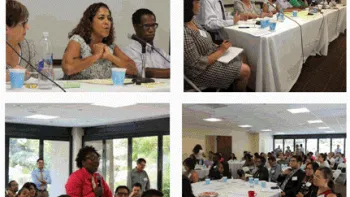
The Healthy, Equitable, Active Land Use (HEALU) Network convened practitioners, policymakers, and community advocates for a summit on Healthy Land Use for All: Elevating Innovation in Los Angeles and Beyond. Over 80 participants engaged in a lively discussion on innovative efforts to promote health equity through land use in Los Angeles and learned from Seattle/King County’s nationally-recognized work to promote equity in all policies. The purpose of the HEALU Network Innovation Summits is to lift up promising, innovative strategies across the country on issues that are integrating health into planning and land use.
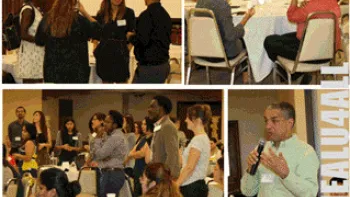
On October 6, 2015, the Healthy, Equitable, Active Land Use (HEALU) Network convened practitioners, policymakers, funders and community advocates to discuss Healthy Development Without Displacement. The crowd consisted of nearly 100 participants engaged in anti-displacement work as well as practitioners seeking to learn more from local and national experts about how the tools and concepts to prevent and/or mitigate displacement apply in their own work. The recent groundswell of Healthy Communities initiatives highlighted an important tension that needed to be addressed: changes to improve community environments, such as walking trails, bike paths, healthy food retail, and parks and open space, can be perceived negatively by residents as precursors to gentrification, and, if no measures are taken to protect current residents, can ultimately lead to displacement of residents who would stand to benefit the most from these very community improvements.
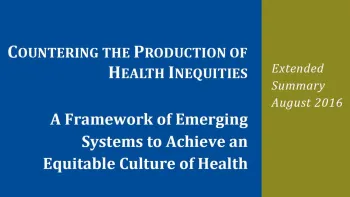
Working as a thought-partner with the Robert Wood Johnson Foundation, PI conducted an analysis to determine the sectors and systems to engage for achieving health equity, and pinpointing the actions to accomplish to achieve equitable outcomes. The analysis resulted in Countering the Production of Inequities: A Framework of Emerging Systems to Achieve an Equitable Culture of Health. The framework underscores how historical and current policies and laws, practices and procedures produce inequities in health outcomes to inform a concrete understanding of how to begin to reverse or ameliorate the inequities and support communities in transforming to achieve an equitable culture of health.
The Fruitvale Transit Village Project is a community-centered transit oriented approach that connects the local transit station with the surrounding community of Fruitvale, a low-income, predominantly minority community in Oakland, California.
Join us in advancing health equity and community empowerment — get in touch today to support the Prevention Institute’s efforts.