Health equity means that everyone has a fair and just opportunity to attain their full health potential and that no one is disadvantaged, excluded, or dismissed from achieving this potential. At Prevention Institute, we focus on how structural drivers of inequity—such as racism, sexism, and income inequality—impact communities. And we support community-based organizations and advocates in building power and capacity to change the systems that created these inequities in the first place.

Racial justice is a primary focus of Prevention Institute’s health equity work because racism, discrimination, and other forms of racial injustice have resulted in dramatic health and safety disparities for communities of color. Without closing racially unjust gaps in health outcomes, we will not be able to achieve health, safety, and wellbeing for our nation as a whole.

Our work is implemented through partnerships and collaborations with coalitions, public health departments, and community-based organizations; and centers the lived experiences of communities whose voices have been historically excluded and underrepresented. We bring our tools and frameworks to inform and build capacity toward effective prevention, racial justice, and health equity strategy development. Our staff are our champions who bring both professional and personal experience to the table and help shape equity solutions that support community health, safety, and wellbeing

Bridging Health Equity & Racial Justice > Content Buckets
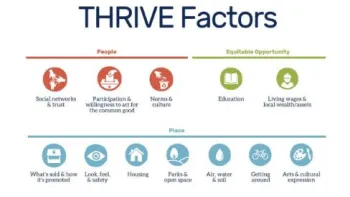


The staff of Public Health Institute brought THRIVE to Planada, California to engage youth to address pedestrian safety. After using Photovoice to assess community conditions related to pedestrian safety, the group decided to focus on promoting safe routes to school. To advance safe routes to school, the youth engaged in a multi-faceted campaign, including efforts to create policy change.

After the Louisiana Public Health Institute (LPHI) participated in a THRIVE training-of-trainers, LPHI staff applied the concepts of THRIVE to spark organizational change. They created a health equity workgroup and expanded the focus of their ongoing initiatives and coalition to include community environments. They trained community activists on THRIVE and saw quick outcomes with the development a community garden.  

Decisions about how land is used, by whom, and for what purposes hold immense potential to prevent violence before it occurs, but land use decisions are rarely made with violence prevention in mind. This publication offers recommendations for creating safer communities through a deeper understanding of the intersection of place and safety.

Learn more

The Safe Routes to School National Partnership is a network of more than 300 nonprofit organizations, government agencies, schools, and professionals working together to advance the Safe Routes to School (SRTS) movement in the United States. Prevention Institute participates in monthly steering committee meetings, providing expertise on health equity and injury and violence prevention.

A Healthy Future for California is a call to action that outlines key priorities and recommendations that California policymakers can use to create a healthier, safer and more equitable state.

Learn more

In 2004, communities in the western unincorporated area of Alameda County (known as the "Eden Area") came together to identify, discuss, and debate the most important issues facing their communities. This was the beginning of the Eden Area Livability Initiative (EALI), and the goal was to develop a collective vision of livable communities and a prioritized set of actions. The first phase of the EALI spanned the period from 2004 to 2012, and the second phase of EALI was initiated in 2012. Community-led Visioning Groups and a Blue Ribbon Steering Committee were tasked with developing and

Learn more

Collaborate With Us

Join us in advancing health equity and community empowerment — get in touch today to support the Prevention Institute’s efforts.