

PI's Weekly Media Digest: How public health fared in 2018 midterms, asylum ban takes shape, and DOJ sharply curtails use of consent-decrees to reform abusive police depts
Democrats retook the US House of Representatives after eight years of Republican control. This will give Democrats power to chair committees, investigate Trump administration agencies and policies (like the move to add a citizenship question to the 2020 Census or political loyalty lists targeting career Environmental Protection Agency staff), set rules for floor debates, advance legislation, and block legislation like further Affordable Care Act repeal attempts. Republicans gained seats in the US Senate, which will give President Trump greater flexibility to confirm political appointees to his administration and federal judges.
An unprecedented 3,784 women, including many women of color, were on this year’s ballot in US elections, with winning candidates including the first two Native American women, the first two Muslim American women, and the first Korean-American woman ever to be elected to the US Congress. Alexandra Ocasio-Cortez, Abby Finkenauer, and Lauren Underwood became the youngest, second-youngest, and third-youngest women ever elected to Congress. Texas elected its first two Latina candidates to the US House. Gun-safety advocate and “Mother of the Movement” Lucy McBath won in Georgia’s sixth Congressional district. McBath became involved in gun-safety advocacy and the Black Lives Matter movement after her unarmed teenage son, Jordan Davis, was shot and killed in 2012 by a white man. McBath said, “I’ve spent all this time championing for gun violence prevention; I’ve been helping to build this big organic movement for gun violence prevention…but if we do not get people in on the inside, it is going to be much, much harder to change the culture and it will take much, much longer.”
Voters in many parts of the country, especially African-American communities, experienced serious delays, broken voting machines, voter intimidation, and other hurdles to voting, including new or pre-existing voter suppression tactics. The National Hotline for Voter Complaints fielded over 20,000 calls.
According to CityLab, the United States contains 34 “purely urban congressional districts.” After this week’s elections, Democrats represent all 34.
Up to 500,000 low-income Americans could gain Medicaid coverage as a result of midterm results. Idaho, Nebraska, and Utah passed ballot initiatives to expand Medicaid, and Kansas, Maine, and Wisconsin elected new governors who are likely to pursue the Medicaid expansion that previous governors rejected.
Florida restored voting rights to 1.5 million people with felony records who have completed their sentences via ballot measure. Washington Monthly reports that “Florida’s criminally disenfranchised population has ballooned to represent more than a quarter of the country’s 6.1 million people who can’t vote because of a felony record. Volz and others who’ve been out campaigning told me that many people they talk to know someone impacted by the law. That’s not surprising given the data: One in ten Floridian adults have a felony conviction. While black Americans are disproportionately arrested and incarcerated nationally, the majority of Floridians with felony convictions are actually white. “Florida uses its prison system as a substitute for treatment for drug addiction and mental health counseling,” said Howard Simon, Executive Director of ACLU Florida.”
In California, statewide ballot propositions to fund housing bonds and housing and services for the homeless passed, but voters declined to give local governments the power to enact new rent control policies. A proposal to repeal the 12-cent per gallon gas tax that funds infrastructure, transit, and active transportation programs was rejected by voters. In Los Angeles, Measure W, which would levy a new parcel tax to fund stormwater collection has gained 67.48% approval, just over the 66.7% needed to pass. “Measure W will help us manage scarce water resources more effectively for our children and our children’s children,” said Supervisor Sheila Kuehl, chair of the Board of Supervisors. “Without Measure W, we faced an ever more urgent challenge to meet our water needs,” she said. “L.A. County currently loses an estimated 100 billion gallons or more of water during annual rainstorms, enough to meet the needs of more than 2.6 million people for an entire year. We simply can’t afford to let that water run down the drain. I’m gratified that L.A. County voters recognized the need and were ready to take up the task.” Urban Habitat breaks down how Bay Area ballot measures fared on Election Night here. CityLab summarizes transportation- and transit-related ballot measures in California and beyond here.
Anticipating the possible repeal of Roe v. Wade, voters in Alabama and West Virginia approved ballot measures that would effectively ban abortion if Roe falls. Of the Alabama amendment, Katie Glenn, state director of Planned Parenthood Southeast, said, “This constitutional amendment will serve as a mandate to pursue even more extreme restrictions and bans… This is just one more example of out-of-touch politicians trying to control women’s decisions and shame them for their most personal reproductive care decisions.”
Ohio voters rejected a ballot measure that would have de-felonized drug possession in the state and enacted other measures to curb mass incarceration. Vox reports that “Issue 1 would have … [reduced] all drug possession offenses to misdemeanors. It also would have made it harder to imprison or jail people for such offenses, reduced the use of prison time for non-criminal probation violations, and let people in prison, except those incarcerated for murder, rape, or child molestation, seek sentence reductions up to 25 percent if they participate in rehabilitative programs, up from 8 percent under current rules. It would have applied the financial savings (from having fewer people in prison) to addiction treatment programs and crime victim funds. But voters rejected the measure. The proposal was put forward by the Ohio Safe and Healthy Communities Campaign, also known as Yes on 1. Financially, it received a lot of outside support — including from the Chan Zuckerberg Initiative (which is in part owned by Facebook founder Mark Zuckerberg), the Open Society Policy Center (founded by liberal billionaire George Soros), and the Open Philanthropy Project. Issue 1 became politically contentious in the state. Ohio Attorney General Mike DeWine, the Republican running for governor, said it would be “devastating,” arguing that it would attract more drug dealers to the state. (There’s no evidence for this claim.) Richard Cordray, the Democratic candidate for governor, argued that the measure would “set the way toward a policy of being smart on crime in the future, smart on how we use taxpayers’ dollars, smart on how we build people’s potential to be productive citizens in our society.” Only five states have defelonized drugs. It started with California in 2014, when its voters approved Proposition 47. Since then, Connecticut, Utah, Alaska, and Oklahoma have enacted similar measures, according to a report on the laws by the Urban Institute’s Justice Policy Center.”
Oregon and Washington State voters weighed soda industry-sponsored ballot measures that would preempt future taxes on sugary drinks. Oregon voters resoundingly rejected the proposal, while Washington State voters approved the ban on future sugar-sweetened beverage taxes.
The new Global Burden of Disease study looks at the causes and risk factors of illness and death in every country in the world and finds that approximately one in five deaths is related to an unhealthy diet. The Guardian reports on its latest findings: “Experts say the latest findings reflect an accelerating shift away from deaths relating to infections and problems around birth and towards diseases such as cancer and diabetes… Almost 20% of deaths worldwide are attributable to an unhealthy diet, with high blood pressure and smoking completing the top three risk factors for reaching the grave, according to a new report on the state of the world’s health. The study, which focuses on 2017, has revealed that non-communicable diseases such as cancer and diabetes now account for nearly three-quarters of the 55.9m deaths worldwide, with experts stressing a large proportion of these are unnecessarily early. ‘A lot of these problems are potentially preventable: things like high blood pressure and smoking are still causing a massive burden of mortality and ill-health,’ said Prof John Newton, director of health improvement at Public Health England and a collaborator on the project.”
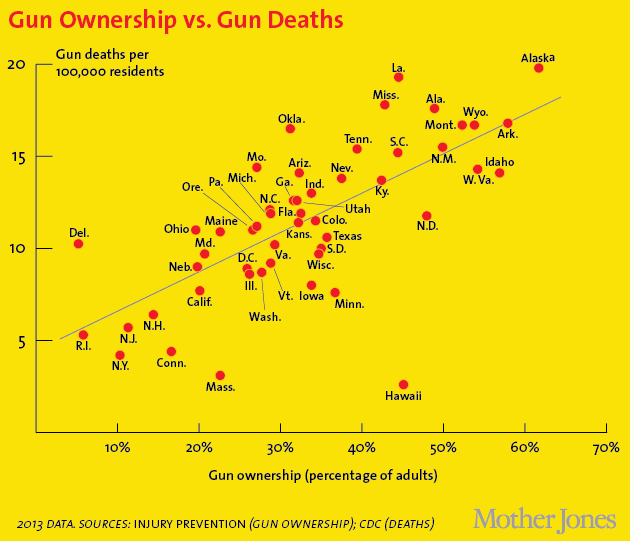
A mass shooting in Thousand Oaks, California, claimed 12 lives this week. A New York Times article drew attention to the oversupply of firearms in the US as driving disparities in injuries and fatalities across multiple forms of violence when compared to other countries: “They concluded that the discrepancy, like so many other anomalies of American violence, came down to guns… More gun ownership corresponds with more gun murders across virtually every axis: among developed countries, among American states, among American towns and cities and when controlling for crime rates. And gun control legislation tends to reduce gun murders, according to a recent analysis of 130 studies from 10 countries. This suggests that the guns themselves cause the violence… As with any crime, the underlying risk is impossible to fully erase. Any individual can snap or become entranced by a violent ideology. What is different is the likelihood that this will lead to mass murder…. In 2013, American gun-related deaths included 21,175 suicides, 11,208 homicides and 505 deaths caused by an accidental discharge. That same year in Japan, a country with one-third America’s population, guns were involved in only 13 deaths... The United States is one of only three countries, along with Mexico and Guatemala, that begin with the opposite assumption: that people have an inherent right to own guns. The main reason American regulation of gun ownership is so weak may be the fact that the trade-offs are simply given a different weight in the United States than they are anywhere else… After Britain had a mass shooting in 1987, the country instituted strict gun control laws. So did Australia after a 1996 shooting. But the United States has repeatedly faced the same calculus and determined that relatively unregulated gun ownership is worth the cost to society. That choice, more than any statistic or regulation, is what most sets the United States apart.”

Shortly before he was fired by President Trump on Wednesday, Attorney General Jeff Sessions wrote a memo that curtails the ability of federal law enforcement officials to use consent decrees to oversee and reform local police departments that have committed civil rights violations and other abuses. The New York Times reports that the move “means that the decrees, used aggressively by Obama-era Justice Department officials to fight police abuses, will be more difficult to enact. Mr. Sessions had signaled he would pull back on their use soon after he took office when he ordered a review of the existing agreements, including with police departments in Baltimore, Chicago and Ferguson, Mo., enacted amid a national outcry over the deaths of black men at the hands of officers. Mr. Sessions imposed three stringent requirements for the agreements. Top political appointees must sign off the deals, rather than the career lawyers who have done so in the past; department lawyers must lay out evidence of additional violations beyond unconstitutional behavior; and the deals must have a sunset date, rather than being in place until police or other law enforcement agencies have shown improvement.”
On Thursday, the Trump administration issued a new rule that would empower the president to deny the rights of certain immigrants crossing the southern border of the US – who have been explicitly barred from entering the US by executive order – to request asylum. Vox reports that “under US law, people who enter the US without papers are legally able to apply for asylum unless they are subject to specific restrictions. This policy would turn that on its head, by adding a restriction that would affect the majority of the 10,000 people a month — most of them Central Americans, and many of them children or families — currently turning themselves in to border agents in hopes of being protected from violence in their home countries.” Legal challenges are expected once the president issues an executive order barring specific groups of immigrants from applying for asylum, which he is expected to do today.
Marion Nestle’s new book, Unsavory Truth, investigates how corporate funding and conflicts of interest bias food research. In an interview with Vox, Nestle explains how food science evolved alongside the food industry to facilitate the development of new products designed to appeal to and hook consumers: “Food companies don’t want to fund studies that won’t help them sell products. So I consider this kind of research marketing, not science. People who do the studies say the conduct of their science is fine, and it well may be. But research on where the bias comes in says the real problem is in the design of the research question — the way the question gets asked — and the interpretation of results. That’s where the influence tends to show up.” Nestle also advocates for restricting marketing to children: “Without question, we need to regulate the marketing of junk food to children. Soda companies shouldn’t be permitted to market sugary beverages — which have sugars and water and nothing else of nutritional value — to kids. For other foods, the situation is more complicated. Foods, even if they’re high in fat, sugar, and salt, have got other kinds of nutrients. So do food companies have a right to make junk foods and market them? Yes, they do, but they should be held to ethical and nutritional standards… But here’s where politics comes in. All attempts to try and regulate marketing to kids have failed, starting in the late ’70s. Food company executives tell me that marketing to children is their line in the sand. They need kids to pester their parents, become lifetime consumers, and have an emotional attachment to products they loved as kids.”
A new study of child abuse and neglect estimates the financial cost to the United States at more than $428 million in 2015 alone. The study tracked short- and long-term impacts of child abuse and neglect, including chronic disease, behavioral health, healthcare, child welfare services, lost productivity, and criminal justice system expenses.
Last week, 22 consumer and public health advocacy groups called on the Federal Trade Commission to investigate and regulate the children’s gaming app market, accusing many apps of “lur[ing] young children to make purchases and watch ads.” Campaign for a Commercial-Free Childhood’s executive director Josh Grolin said new research shows that the presence of ads in games targeting children as young as preschool age “are extremely disruptive and often overwhelm the playing experience. That’s unfair to children and deceptive to parents who think they are downloading games which are educational. It’s fundamentally unfair to manipulate a young child who doesn’t understand what is happening.
Montana voters rejected a ballot initiative that would have extended funding for the Medicaid expansion past June 2019, in part by raising taxes on cigarettes and other tobacco products.
Portland, Oregon, voters approved the Portland Clean Energy Community Benefits Initiative, a ballot measure that will implement a 1% surcharge on large retail corporations to fund clean energy projects and green infrastructure, with at least 50% of projects to "specifically benefit low-income residents and communities of color."
The Food and Drug Administration plans to ban the sale of most flavored e-cigarette cartridges and introduce new age-verification measures for online sales to reduce the popularity of vaping among teenagers.