At Prevention Institute, our vision is that all people experience their full potential for health, safety, and wellbeing across the life course through thriving, equitable communities. Safety allows people to thrive and live fulfilling lives—it is freedom from violence and the threat of violence. Our work addresses multiple forms of violence (e.g., school, community, intimate partner, sexual assault, and child abuse and exploitation) and the relationships between them.

Violence is preventable, not inevitable. There is a strong and growing evidence base, grounded in research and experiential practitioner and community evidence that supports this fact. Changing the underlying conditions that contribute to violence—in homes, schools, and neighborhoods—prevents violence from occurring in the first place.

Prevention Institute engages leaders from housing, healthcare, and multiple other sectors at the local, state, and national levels and cultivates a systems approach to prevention that reduces the need for criminal justice intervention. Recognizing violence as a crucial prevention issue for health and equity, Prevention Institute has made a major commitment to helping cities devise comprehensive plans and strategies for reducing and preventing multiple forms of violence. By cultivating communities of practice such as UNITY (Urban Networks to Increase Thriving Youth through Violence Prevention) and Safety Through Connection, supporting policy and systems change, and providing strong technical assistance, Prevention Institute catalyzes momentum for safety.

Safety > Content Buckets

The Tacoma-Pierce County Health Department embraced the ACE|R Framework in its community-driven planning process to improve mental wellbeing for boys and men of color and LGBTQ youth, particularly in efforts that focus on healing as a starting point for collective action.

As one of eight communities in the California Accountable Communities for Health Initiative, the East San Jose Peace Partnership has used ACE|R as its overarching framework. This emphasis has helped the project to remain focused on community level change strategies and provided a structure for expanding its focus to address multiple forms of violence.

In City Heights in San Diego, CA, United Women of East Africa Support Team is addressing community trauma and building resilience in East African men and boys, using ACE|R as the organizing framework for their assessment, planning, and implementation efforts.

Ohio’s Department of Mental Health and Addiction Services is utilizing the Framework to drive its statewide opioid prevention efforts and strategy in partnership with 12 communities. They are specifically using ACE|R to build trauma-informed coalitions and identify drivers of substance misuse.

In November 2017, Milwaukee released its Blueprint for Peace. Grounded in the Framework, the Blueprint identifies forms of violence and structural violence and draws on community assets and best practices to focus on preventing violence, as well as intervention efforts to ameliorate the impacts of violence and prevent future perpetration and victimization. 

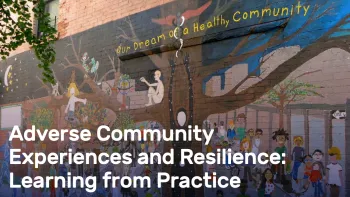
Since the initial development of the Adverse Community Experiences and Resilience Framework in 2016, multiple networks and communities have shared it, as well as adopted, adapted and/or implemented it to address and prevent community trauma. Adverse Community Experiences and Resilience: Learning from Practice reflects valuable lessons from their practice.

Learn more

Cathy Costa presented Baltimore’s Maternal and Child Health (MCH) and violence prevention efforts at the 2016 City MatCH Leadership and MCH Epidemiology Conference. Baltimore has been a long-time member of Prevention Institute’s UNITY City Network. The narrative is excerpted from Cathy’s presentation at this September 2016 event in Philadelphia, PA.

Understanding that there are underlying conditions that contribute to violence, poverty, and negative early childhood outcomes, First 5 Alameda County is using a strengths-based approach and a variety of partnerships to support communities that have faced the greatest disenfranchisement. This narrative is based on two separate presentations of First 5 Alameda County’s place-based work: Lisa Erickson’s presentation during a 2016 Prevention Institute web conference on engaging the community development sector, and Carla Keener’s Cradle to Community panel presentation at the 2016 American Public Health Association’s Annual Meeting.

This report summarizes the 2017 PreventConnect web conference series and represents directions for the field of sexual and domestic violence prevention. It draws together high-level themes that unify the series as a whole, and provides key findings from each of the eight web conferences, allowing the ideas, examples, and resources from the web conferences to live on in written form.

Learn more

Collaborate With Us

Join us in advancing health equity and community empowerment — get in touch today to support the Prevention Institute’s efforts.