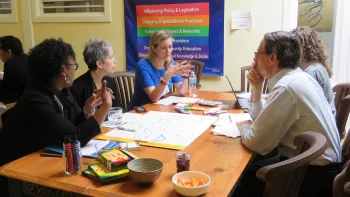
Through intensive collaboration with local groups, Prevention Institute has directly shaped how cities and counties approach the issue of violence and has improved prevention practice broadly.


At Prevention Institute, our vision is that all people experience their full potential for health, safety, and wellbeing across the life course through thriving, equitable communities. Safety allows people to thrive and live fulfilling lives—it is freedom from violence and the threat of violence. Our work addresses multiple forms of violence (e.g., school, community, intimate partner, sexual assault, and child abuse and exploitation) and the relationships between them.
Violence is preventable, not inevitable. There is a strong and growing evidence base, grounded in research and experiential practitioner and community evidence that supports this fact. Changing the underlying conditions that contribute to violence—in homes, schools, and neighborhoods—prevents violence from occurring in the first place.
Prevention Institute engages leaders from housing, healthcare, and multiple other sectors at the local, state, and national levels and cultivates a systems approach to prevention that reduces the need for criminal justice intervention. Recognizing violence as a crucial prevention issue for health and equity, Prevention Institute has made a major commitment to helping cities devise comprehensive plans and strategies for reducing and preventing multiple forms of violence. By cultivating communities of practice such as UNITY (Urban Networks to Increase Thriving Youth through Violence Prevention) and Safety Through Connection, supporting policy and systems change, and providing strong technical assistance, Prevention Institute catalyzes momentum for safety.

Through intensive collaboration with local groups, Prevention Institute has directly shaped how cities and counties approach the issue of violence and has improved prevention practice broadly.

Prevention Institute provided training and technical assistance to the signature violence prevention initiatives funded by the U.S. Office of Juvenile Justice and Delinquency Prevention (OJJDP), including the National Forum for Youth Violence Prevention, Community Based Violence Prevention, and the Defending Childhood Initiative.

Since 2005, Prevention Institute has supported dozens of large U.S. cities to prevent urban violence through the UNITY initiative. UNITY advances a public health approach and works closely with the UNITY City Network to develop prevention strategies that address violence before it occurs.
The Boston Public Health Commission's Violence Intervention and Prevention Initiative (VIP) is grounded in community engagement, an essential element of preventing violence. This publication describes the goals of VIP's five community coalitions, and shares advice for mobilizing residents.

Decisions about how land is used, by whom, and for what purposes hold immense potential to prevent violence before it occurs, but land use decisions are rarely made with violence prevention in mind. This publication offers recommendations for creating safer communities through a deeper understanding of the intersection of place and safety.

Working with the Los Angeles County Department of Public Health Division of Chronic Disease and Injury Prevention, Prevention Institute developed five profiles that highlight the importance of community partnerships to advance prevention strategies focused on making Los Angeles a healthier, safer, and more equitable place to live.

To clarify the relationships among eight forms of violence, Prevention Institute developed Connecting the Dots with the U.S. Centers for Disease Control and Prevention to build a case for practitioners to coordinate their efforts, increase their impact, and work toward preventing multiple forms of violence at once.

There is growing recognition that preventing violence means engaging many sectors, but collaboration can be difficult. This publication outlines the benefits and challenges of multi-sector collaboration, and illustrates how the Collaboration Multiplier tool can help with an example out of Houston. It features a Collaboration Multiplier grid with information about seven public sectors, as well as a sample analysis for how community services, the economic sector, schools and public health might work together to prevent violence. Developed with funding from The Kresge Foundation, "A Multi-Sector
UNITY has enhanced and built capacity of U.S. cities to prevent violence using the public health approach since 2005, and more than 70 percent of national partners see UNITY as a viable model for preventing violence. This initiative has improved collaboration among cities, national partners and community members, developed useful tools, and provided a forum for cities to work together on critical issues. Read this publication for a discussion of major findings from the 2013 UNITY evaluation, UNITY Eight-Year Assessment: Results of an Innovative Initiative to Improve the Urban Response to Youth
Young people are powerfully affected by the environments they grow up in, and this has implications for preventing violence. In many neighborhoods across the U.S., entire communities experience traumatizing events and conditions. This publication summarizes a conversation between UCSF Professor Howard Pinderhughes and UNITY Project Director Rachel Davis on community-level trauma and what can be done about it. Read other publications in the Making the Case series.
Join us in advancing health equity and community empowerment — get in touch today to support the Prevention Institute’s efforts.