
The health delivery and payment system is undergoing rapid transformation in an effort to reduce cost and achieve better health outcomes. Community prevention is a valuable strategy for reducing

The health delivery and payment system is undergoing rapid transformation in an effort to reduce cost and achieve better health outcomes. Community prevention is a valuable strategy for reducing illness and injury in the first place while supporting the Triple Aim of improved population health, lower costs, and improved outcomes. Prevention Institute envisions a transformed health delivery and payment system that advances health and equity through quality community-based prevention practices.
The health delivery and payment system is undergoing rapid transformation in an effort to reduce cost and achieve better health outcomes. Community prevention is a valuable strategy for reducing

Mental health is at the heart of many of the challenges we face, including trauma and adverse childhood experiences, social isolation, institutionalized bias and discrimination, and ‘diseases of despair’ that manifest in depression, suicide, and substance misuse. Addressing social determinants of health is key to helping communities navigate adversity, heal, and flourish. PI’s report, Back to Our Roots: Catalyzing Community Action for Mental Health and Wellbeing, illustrates how improving community conditions can reduce the incidence and intensity of mental health challenges, and help activate resilience.
To download a PDF version of this infographic, click here. The infographic captures the approaches detailed in our paper Disrupting the Pathway, A Medical Approach to High Utilization.
An Accountable Community for Health is a structured, cross-sectoral alliance of healthcare, public health, and other organizations that plans and implements strategies to improve population health and health equity for all residents in a geographic area.
The Accountable Community for Health (ACH) model provides a powerful opportunity for healthcare institutions to prepare for the collaborations necessary to succeed in this new health ecosystem. This brief outlines the ACH model, provides examples of relevant collaborations emerging throughout the country, and recommends several concrete actions for organizations interested in taking the next step toward adopting the ACH approach.

Disrupting the Pathway explores a primary prevention approach to reduce frequent utilization of high-cost healthcare services and includes model strategies that healthcare organizations and their community partners can collectively implement to improve community conditions that have a role in producing high utilization and subsequent costs.
Community leaders across the country are exploring the Accountable Communities for Health (ACH) model as an innovative opportunity to pursue population health improvement and health equity. The core of the ACH approach is harnessing the collective efforts of health stakeholders including healthcare, public health, behavioral health, school districts, other governmental entities, and community- and faith-based organizations. The success of this type of approach has been demonstrated repeatedly over the last 50 years through health improvement efforts that have incorporated both individual
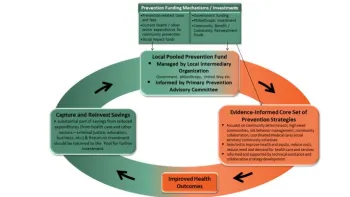
Published by the Institute of Medicine’s Roundtable on Population Health Improvement, Closing the Loop outlines some of the essential elements of sustainable funding mechanisms and argues that we need to “close the loop” by ensuring that when prevention efforts DO save money, substantial portions of that money get plowed back into prevention.
When a Chinatown resident was struck and killed by a car while crossing the street, the incident made Asian Health Services (AHS) staff aware of pedestrian safety as a health issue in their community. To better understand how to address structural factors influencing the community, AHS and the Oakland Chinatown Chamber of Commerce opened up a community design conversation that convened urban planners, designers, architects, and artists who together developed and proposed innovative ways to revitalize Chinatown.
St. John’s has seen a ninety-five percent reduction in elevated lead levels as well as reductions in hospital admissions related to asthma. St. John’s commitment to supporting education, socio- economic, and mental health services, the health center has become an asset to other community organizations and an example of how the Community-Centered Health Home model can be manifested over time to address root causes of health issues that affect population health.
Join us in advancing health equity and community empowerment — get in touch today to support the Prevention Institute’s efforts.