
For the fundamentals on UNITY, we invite you to begin with these publications:

You can also find strategies, tools and resources on this topic in our UNITY initiative area, or browse all related publications, below.

Recognizing positive early childhood development as an important component of a comprehensive violence prevention strategy, the New Orleans Health Department is working to bridge their community safety and early childhood efforts. Chris Gunther presented on New Orleans’s violence prevention and early childhood work as part of a Cradle to Community panel at the 2016 American Public Health Association’s Annual Meeting in Denver, CO. This narrative is excerpted from his remarks.
Learn more

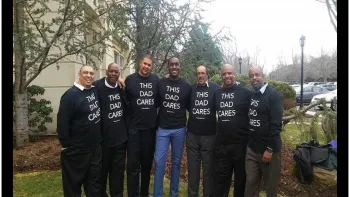
Fathers and father figures are essential members of families and communities who play many roles, including raising children and fostering safety in the community. As part of the national project, Cradle to Community: A Focus on Community Safety and Healthy Child Development funded by the Robert Wood Johnson Foundation, this brief outlines challenges and barriers in the early childhood system and the criminal justice system, opportunities for systems changes, and examples of on the ground efforts to change systems, norms, and outcomes.

Learn more

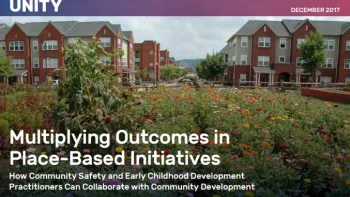
As part of the national project, Cradle to Community: A Focus on Community Safety and Healthy Child Development funded by the Robert Wood Johnson Foundation, this brief shares key findings and answers questions on what the community development sector does and how it relates to early childhood and violence prevention. The brief builds on the overlap between the sectors and puts forth what multisector collaboration could look like between the three sectors, including challenges, tips, potential shared outcomes, partner strengths, and examples of local joint strategies.

Learn more

This report by Prevention Institute and the Center for the Study of Social Policy makes the case for action and delineates opportunities for systems, policy, and practice change at the intersection of community safety and positive early child development. For example, emergent opportunities at the intersection include changing norms about fathers and fatherhood through systems and practice change; engaging the community development sector to address housing issues through policies and practices; and building the early education to employment pipeline through state and local policy change.

Learn more

This PI-authored article published in the Journal of Public Health Policy’s special issue on Violence and Health: Merging Evidence and Implementation details how comprehensive strategies to improve community conditions can reduce violence and promote health equity. It describes how PI tools and frameworks, used by our Urban Networks to Increase Thriving Youth (UNITY) cities, can be adapted for international application in multi-sector collaboration, influencing policy and legislation, and strengthening local violence prevention efforts.

Learn more

Direct experience as well as exposure to multiple forms of violence can have a compounding negative impact on children’s development. Despite the strong relationship, the fields of practice addressing different forms of violence have largely been silo-ed. This brief summarizes five connections between child maltreatment, intimate partner violence, and community violence and makes the case for an integrated movement for safety in our homes and communities. It draws on recent research and analysis on the linkages between multiple forms of violence and offers examples of emerging actions to address the linkages.

Learn more

Adverse community experiences – such as concentrated poverty, segregation from opportunity, and community violence – contribute to community trauma, which can exacerbate adverse childhood experiences (ACEs). This brief explains the relationship between ACEs and adverse community experiences, thus making the case for focusing on preventing and addressing trauma at the community level, in addition to the growing focus on individual trauma. It also provides examples of emerging strategies to address community trauma and build community resilience.

Learn more

Community violence interferes with young children’s attainment of key competencies — cognitive, sensory, muscular, emotional, social and behavioral — and compromises the capabilities of caregivers to provide supportive environments for their children. However, communities provide the conditions in which people can live free from fear of violence and harm from violence; they support opportunities for active learning and optimal growth in the early years. This fact sheet highlights the research on the relationship between community safety and positive early childhood development. Further, it

Learn more

In recognition of the dramatically shifting national landscape, and with support from the Robert Wood Johnson Foundation and Kaiser Permanente Community Benefit, nearly 25 leaders in community violence prevention gathered to strategize about where we go from here – for cities and counties, and as a network and movement – in support of safer communities. The meeting’s dialogue and outcomes underscore the value of speaking truth to power. While the meeting leveraged relationships forged through Prevention Institute’s UNITY City Network, the key themes and directions highlight the state of

Learn more

Collaborate With Us

Join us in advancing health equity and community empowerment — get in touch today to support the Prevention Institute’s efforts.